
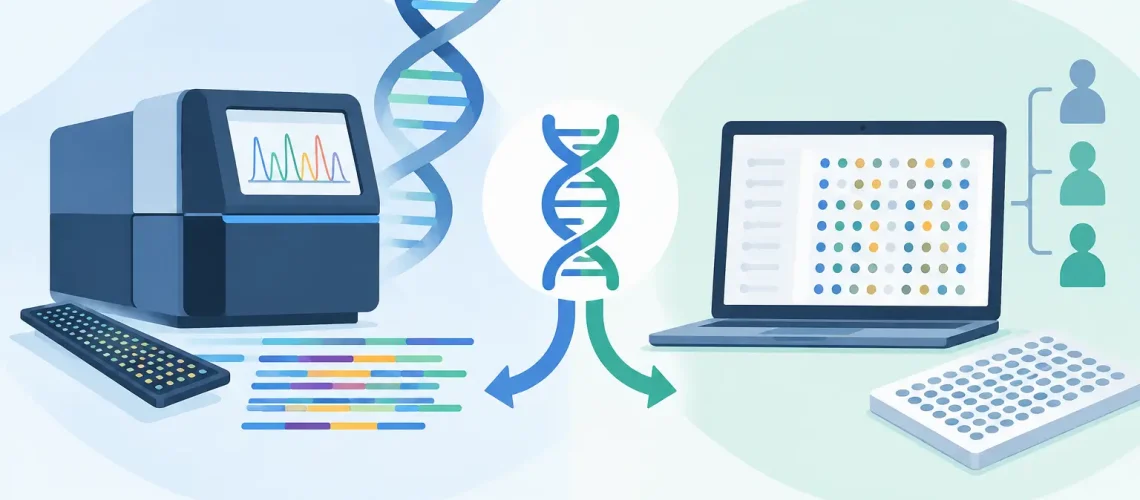
A single unexpected variant can change the direction of a research program, while a high-throughput screen can lose its value if it cannot process the required cohort on time. That is why sequencing vs genotyping is not simply a question of selecting the more advanced technology. It is a decision about the biological question, the level of evidence required, the expected sample volume, and the workflow your laboratory can sustain.
For research institutions, clinical laboratories, and biotechnology teams, the right choice can reduce turnaround time, control cost per reportable result, and produce data that is genuinely actionable. The wrong choice can generate elegant datasets that do not answer the study objective, or inexpensive results that miss the variants that matter.
Sequencing vs Genotyping: The Core Difference
Genotyping determines which known genetic variants are present at predefined genomic positions. A laboratory may test a selected set of single-nucleotide polymorphisms, specific pathogenic variants, or markers associated with a trait, treatment response, or disease risk. Common approaches include PCR-based assays, allele-specific methods, and SNP arrays.
Sequencing determines the nucleotide order across a targeted region, panel, exome, or whole genome. Rather than asking whether a sample contains one of several expected alleles, sequencing can reveal the underlying bases across the region under investigation. This enables detection of known variants and, depending on assay design and analytical performance, previously uncharacterized variants.
The distinction affects nearly every downstream decision. Genotyping is typically optimized for fast, repeatable interrogation of established markers. Sequencing is designed for broader genetic characterization, variant discovery, and deeper interpretation. Neither approach is universally superior. Their value depends on whether the study seeks confirmation or discovery.
When Genotyping Is the Better Operational Choice
Genotyping is often the most efficient solution when the relevant variants are already well defined. For example, an agricultural breeding program may screen a large population for validated trait-associated markers. A pharmacogenomics workflow may need to identify a limited set of alleles that guide medication selection. A quality-control team may verify cell line identity using an established marker panel.
In these settings, a focused genotyping assay can offer predictable turnaround, straightforward data outputs, and lower cost per sample at scale. It also simplifies laboratory operations. Assay design, controls, acceptance criteria, and reporting rules can be standardized once the marker set has been validated.
This is particularly valuable when hundreds or thousands of samples must be processed consistently. The result is not a broad genomic profile, but a direct answer to a defined question: does the sample carry the variant or genotype of interest?
Genotyping has clear constraints. It cannot reliably identify a variant that is not represented in the assay design, and it offers limited context around detected markers. If a disease-associated locus contains rare, novel, or complex alterations, a targeted genotyping method may return a negative result even though clinically or scientifically relevant variation is present nearby.
When Sequencing Adds Decisive Value
Sequencing is the stronger choice when the project requires discovery, comprehensive characterization, or resolution beyond a fixed marker set. Targeted sequencing panels are widely used where multiple genes or mutational hotspots contribute to a phenotype. Whole-exome sequencing may be appropriate for studies focused on protein-coding variation, while whole-genome sequencing extends visibility into coding and noncoding regions.
In oncology research, for example, sequencing can identify a spectrum of mutations across genes and pathways rather than testing only a small set of known hotspots. In rare-disease investigation, it can support the search for variants not anticipated at study design. In microbial surveillance, sequencing can provide the detail needed to distinguish strains, track transmission patterns, and monitor emerging mutations.
That broader view comes with analytical responsibility. Sequencing data requires appropriate coverage targets, quality thresholds, bioinformatics pipelines, variant calling, annotation, and interpretation. Detecting a sequence difference is not the same as establishing its biological or clinical relevance. Laboratories must define how variants will be filtered, reviewed, confirmed when necessary, and reported.
Sequencing also has its own blind spots. Coverage can vary across regions, some structural variants and repeat expansions require specialized methods, and low-frequency variants may demand deeper sequencing and carefully validated sensitivity thresholds. A well-designed assay matches its technical limitations to the decisions it is expected to support.
Compare the Questions Before Comparing Platforms
The most productive starting point is not a platform specification. It is a clear statement of the question the data must answer. If the objective is to detect a known set of actionable variants in a high-volume cohort, genotyping may deliver the required result with greater operational efficiency. If the objective is to understand why samples differ, identify new candidate variants, or characterize heterogeneous disease biology, sequencing is usually the more appropriate foundation.
Consider the expected outcome. A binary positive or negative result for a defined allele favors genotyping. A variant list across multiple genes, with the possibility of novel findings, favors sequencing. A project may also use both methods: sequencing during discovery and assay development, followed by genotyping for large-scale validation or routine screening.
This staged model is common in applied R&D. Early sequencing generates the evidence needed to select informative markers. A subsequent genotyping assay can then convert those findings into a scalable workflow for larger cohorts, manufacturing quality control, population studies, or diagnostic development.
Cost Means More Than Price Per Sample
Genotyping frequently has a lower direct cost per sample when a laboratory is screening a limited, established marker set at volume. However, the least expensive assay is not always the lowest-cost decision. If a targeted assay produces too many unresolved cases, additional testing can eliminate the apparent savings.
Sequencing generally involves higher costs for library preparation, instrument time, data storage, computational processing, and expert review. Yet its broader information yield may reduce repeat testing and accelerate discovery. The financial comparison should therefore include the cost of inconclusive results, confirmatory testing, data analysis, staff time, instrument maintenance, and the consequences of delayed decisions.
For laboratories building sustained capability, throughput and utilization matter as much as reagent pricing. An underused high-capacity sequencer can be inefficient, while a genotyping workflow may become a bottleneck if the research program expands from a handful of markers to a more complex genomic question.
Sample Quality and Workflow Design Matter
Both approaches depend on fit-for-purpose sample preparation. DNA quantity, purity, integrity, source material, and contamination risk influence results. Degraded clinical specimens, low-input samples, and mixed populations require methods with demonstrated performance under those conditions.
Sequencing workflows can be particularly sensitive to library quality, target enrichment performance, read depth, and contamination control. Genotyping workflows require equally rigorous attention to assay specificity, positive and negative controls, plate layout, and genotype calling thresholds. In either case, pre-analytical controls should be established before sample volume increases.
Laboratory managers should also evaluate infrastructure requirements. Sequencing may require specialized instruments, validated computational environments, secure data management, and trained personnel for bioinformatics review. Genotyping can be easier to operationalize for focused applications, but it still requires calibration, maintenance, quality assurance, and dependable access to consumables and replacement parts.
A Practical Selection Framework
A sound technology decision aligns four elements: biological scope, reporting requirements, sample volume, and available operational capability. Ask whether the variants are already known, whether novel findings must be captured, how quickly a result is needed, and whether the laboratory has the validation and analysis capacity to support the selected method.
For regulated or clinically adjacent applications, analytical validity must be considered separately from research utility. Performance characteristics such as accuracy, precision, sensitivity, specificity, reportable range, and reproducibility should be documented for the intended use. A research-grade discovery workflow cannot automatically support clinical decision-making without appropriate validation and governance.
Pilot studies are often the most reliable path when the answer is uncertain. Testing representative samples can reveal whether coverage, call rates, turnaround time, data interpretation, and total workflow cost meet real operational needs. This evidence is more useful than selecting a technology based solely on headline throughput or instrument specifications.
CLONEX supports this type of decision through integrated scientific solutions that connect molecular biology needs with laboratory operations, analytical capability, instrument support, and tailored implementation planning. The goal is not merely to procure a platform, but to establish a workflow that can perform reliably from sample receipt through result delivery.
The best choice is the one that produces the right level of genetic evidence for the next decision your organization must make. Define that decision first, then build the assay, infrastructure, and quality framework around it.