
A gene-silencing result can look convincing at 48 hours and still be the wrong foundation for a long-term model. That distinction is central to CRISPR versus RNA interference: these are not interchangeable technologies with different reagent catalogs. They change biological systems through different mechanisms, create different experimental risks, and demand different levels of validation.
For research teams building disease models, validating drug targets, or developing diagnostic and therapeutic concepts, the most productive question is not which technology is superior. It is which perturbation best matches the biological question, timeline, cell model, and downstream decision.
CRISPR versus RNA interference: the core distinction
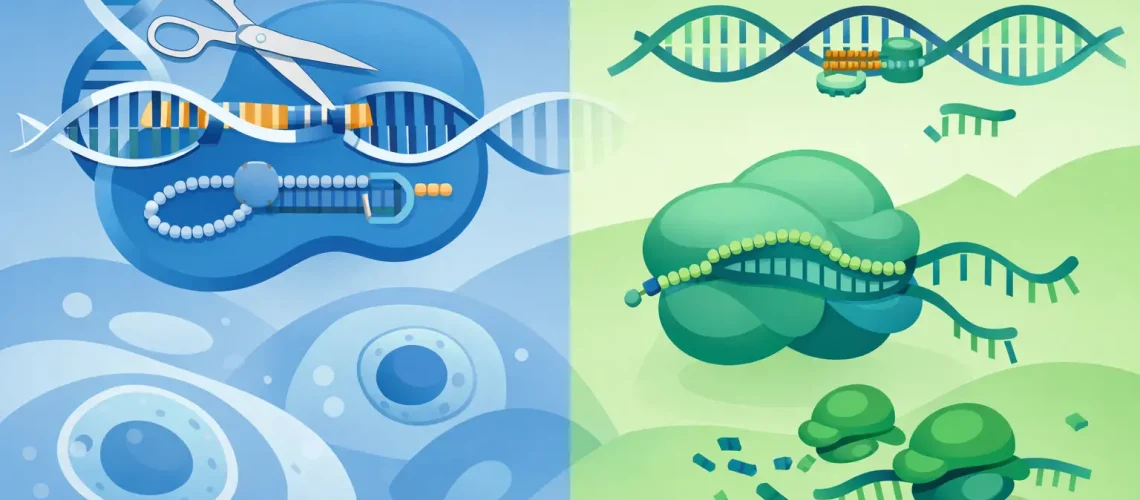
CRISPR systems are best known for targeted genome editing. A guide RNA directs a CRISPR-associated nuclease, commonly Cas9, to a defined DNA sequence, where the system creates a double-strand break. Cellular repair can then introduce insertions or deletions that disrupt a gene, or, with appropriate donor templates and editing architectures, install a defined sequence change.
RNA interference, or RNAi, acts after transcription. Small interfering RNAs (siRNAs), short hairpin RNAs (shRNAs), and related molecules guide the RNA-induced silencing complex to complementary messenger RNA. The target RNA is cleaved or its translation is suppressed, reducing protein production without changing the underlying DNA sequence.
This difference determines the experimental outcome. Standard CRISPR knockout approaches seek a durable genomic alteration that can persist through cell division. RNAi usually produces a reversible or time-limited reduction in gene expression. CRISPR can therefore answer whether a gene is required over multiple generations, while RNAi can be better suited to assessing what happens when expression is partially reduced during a defined experimental window.
Neither description should be treated as absolute. CRISPR interference, often called CRISPRi, uses a catalytically inactive Cas protein fused to transcriptional repressors to reduce gene transcription without cutting DNA. Conversely, stable shRNA expression can sustain RNAi-mediated knockdown for extended periods. The choice depends on the specific implementation, not simply the label on the technology.
What each approach measures in practice
A complete knockout and a partial knockdown are biologically different perturbations. If a protein has residual activity at low abundance, RNAi may reveal a phenotype that differs substantially from a CRISPR knockout. This is particularly relevant for essential genes, dosage-sensitive pathways, and signaling networks with feedback control.
CRISPR knockout is often valuable when the objective is to establish a stable isogenic cell line, investigate loss-of-function genetics, or create a durable model for screening. A properly characterized edited clone can provide a reusable research asset, although clone selection itself can introduce bias. Cells may adapt to the loss of a gene over time, and a surviving clone may not represent the immediate biological consequence of gene disruption.
RNAi is valuable when a team needs rapid target assessment, graded reduction of expression, or a transient perturbation that avoids permanent genomic modification. In primary cells or challenging cell systems, transient siRNA delivery may provide an efficient first-pass test before investing in genome editing and clone validation. RNAi can also be preferable where complete loss of a gene causes lethality, but a partial decrease produces an interpretable phenotype.
For therapeutic development, the distinction extends beyond experimental design. RNAi therapeutics generally aim to reduce a disease-associated transcript, whereas CRISPR-based therapies may seek a one-time, permanent edit. The potential durability of editing can be transformative, but it raises the threshold for delivery control, off-target characterization, long-term safety assessment, and regulatory evidence.
The trade-offs that shape technology selection
The right choice should be made against a defined set of operational and scientific criteria.
| Decision factor | CRISPR-based editing | RNA interference | | — | — | — | | Molecular target | Genomic DNA | Messenger RNA | | Typical effect | Gene disruption or precise sequence change | Reduced transcript and protein expression | | Duration | Potentially permanent and heritable in dividing cells | Usually transient or reversible, though stable shRNA is possible | | Degree of suppression | Often complete loss of function after validated editing | Frequently partial and dose-dependent knockdown | | Model development | Requires editing, screening, and clone or population characterization | Can be rapid, especially with transient siRNA approaches | | Key technical concern | Unintended editing, repair outcomes, and clonal artifacts | Off-target transcript suppression and variable knockdown efficiency |
Specificity is often oversimplified in conversations about both technologies. CRISPR guide design can reduce unintended genomic editing, but candidate guides still require empirical validation in the relevant model. RNAi reagents can suppress non-target transcripts through seed-sequence effects, especially at higher concentrations. Using multiple independent siRNAs or shRNAs that produce the same phenotype, together with rescue experiments where feasible, remains a strong practice.
A rescue experiment is particularly persuasive because it connects phenotype to target function. In a CRISPR knockout model, reintroducing a functional version of the gene can test whether the observed effect is genuinely caused by gene loss. In an RNAi study, expressing an RNAi-resistant transcript can serve the same purpose. These controls often carry more decision value than a single highly optimized reagent.
Delivery is not an afterthought
A technically elegant construct has limited value if it cannot reach the relevant cells at an acceptable efficiency and viability. Delivery strategy influences performance for both CRISPR and RNAi, especially in primary cells, suspension cultures, organoids, and clinically relevant tissue systems.
CRISPR components may be delivered as plasmid DNA, messenger RNA, ribonucleoprotein complexes, or viral vectors. Each format has implications for expression duration, editing efficiency, payload capacity, scalability, and safety. Ribonucleoprotein delivery, for example, can limit the duration of nuclease activity, which may help reduce unintended edits, but optimization can be demanding in difficult cell types.
RNAi may be introduced using lipid-based transfection, electroporation, conjugate-based delivery, nanoparticles, or viral expression platforms for shRNA. The practical advantage of siRNA is speed: a team can often evaluate knockdown within days. Yet delivery stress, innate immune activation, and inconsistent uptake can confound the readout. Measuring both target RNA and protein reduction is therefore essential before interpreting a functional result.
Laboratory workflow also matters. A multi-site research program may favor standardized, traceable reagent preparation and repeatable transfection protocols. A discovery team working under time pressure may choose a short RNAi study to prioritize targets, then advance only the strongest candidates to CRISPR-based model generation. This staged approach can conserve budget and reduce avoidable rework.
Choosing the right approach for common research goals
When the goal is rapid target triage, RNAi is often the practical starting point. It supports parallel testing of several targets, provides a relatively quick indication of whether reduced expression changes a phenotype, and avoids the time required to isolate and expand edited clones. Results should still be confirmed with independent reagents and appropriate expression measurements.
When the goal is a stable loss-of-function model, CRISPR editing is generally the stronger fit. It can produce durable genomic disruption and supports repeated assays across growth conditions, drug treatments, and downstream omics workflows. Researchers should decide early whether a pooled edited population is adequate or whether single-cell clones are required. Pooled populations preserve diversity and reduce clonal selection concerns, while clones provide a more defined genotype but require more extensive characterization.
When complete gene loss is not viable, RNAi or CRISPRi may offer a better experimental window. Both can reduce expression without necessarily eliminating it, making them useful for essential genes and pathway analysis. CRISPRi may be particularly attractive for scalable repression screens, while RNAi remains valuable for rapid and flexible knockdown studies.
When the objective is to correct, insert, or precisely alter a DNA sequence, RNAi cannot provide the needed outcome. CRISPR-derived editing platforms, including base and prime editing approaches where appropriate, are better aligned with that requirement. The added capability comes with added analytical demands: edit spectrum analysis, off-target assessment, genomic integrity evaluation, and careful control of editing outcomes.
Build validation into the project plan
The strongest studies treat gene perturbation as a workflow rather than a single reagent purchase. Before selecting CRISPR or RNAi, define the target biology, the expected magnitude and timing of effect, the acceptable viability impact, and the assays that will confirm success. Then establish controls that distinguish a true target-specific phenotype from delivery toxicity, non-target effects, or culture drift.
For CRISPR, validation commonly includes on-target genotyping, protein-level confirmation, assessment of editing heterogeneity, and phenotype replication with independent guides. For RNAi, teams should verify transcript and protein knockdown, compare multiple targeting sequences, and assess whether transfection conditions alter baseline cell behavior. In both cases, experimental records should capture reagent identity, passage number, delivery parameters, assay timing, and data-analysis criteria.
This level of discipline is especially relevant when a project will move from exploratory biology into diagnostic development, preclinical research, or industrial decision-making. A result that cannot be reproduced across batches, operators, or instruments is not yet a dependable development asset.
CLONEX supports this type of applied R&D through integrated molecular biology capabilities, laboratory infrastructure support, and tailored scientific solutions that help teams move from experimental design to reliable execution. The value is not simply access to advanced technologies. It is aligning those technologies with the realities of sample handling, equipment performance, analytical needs, and project timelines.
The most useful choice between CRISPR and RNA interference is the one that makes the next decision clearer. Select the method that produces an interpretable perturbation in the system you actually need to understand, then validate it rigorously enough that the result can carry the project forward.