
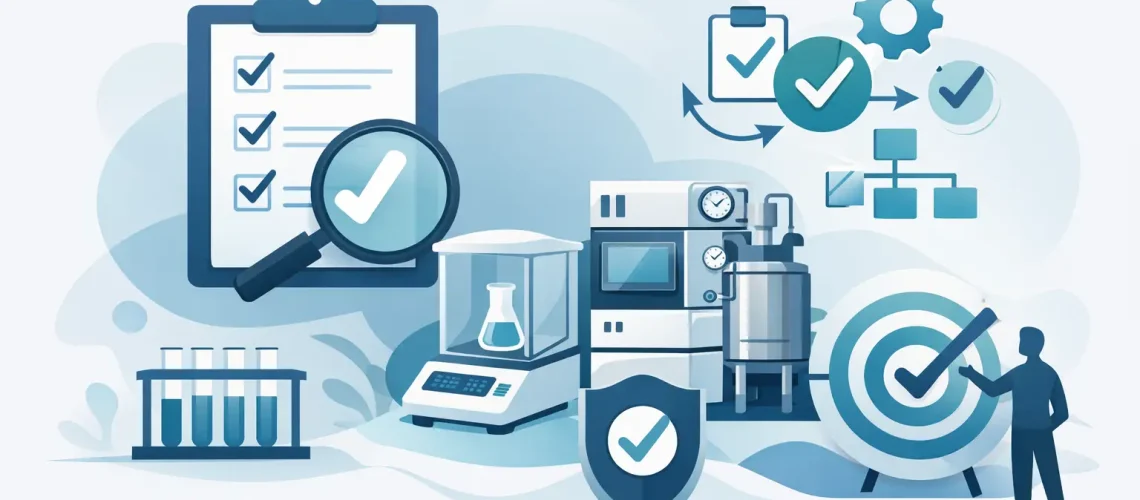
A new analytical instrument can arrive with complete documentation, pass a quick power-on check, and still be unready for regulated or high-stakes work. When laboratory teams ask, “what is instrument IQ OQ PQ?” they are asking how to establish documented evidence that equipment is installed correctly, operates as intended, and consistently supports its intended application.
For research laboratories, hospitals, diagnostic facilities, and industrial operations, instrument qualification is more than a compliance activity. It is a practical control over data integrity, product quality, patient safety, and the cost of failed investigations. IQ, OQ, and PQ provide a structured path from delivery to dependable routine use.
What Is Instrument IQ OQ PQ?
IQ, OQ, and PQ are the three core stages of equipment qualification. They are commonly applied to laboratory instruments and computerized systems used in regulated environments, including pharmaceutical manufacturing, medical devices, clinical testing, food analysis, and quality control laboratories.
Installation Qualification (IQ) confirms that the instrument and its supporting infrastructure have been received, installed, and documented according to approved requirements. Operational Qualification (OQ) demonstrates that the instrument functions across its specified operating ranges. Performance Qualification (PQ) shows that it performs consistently in the real workflow, with the samples, methods, operators, and conditions that matter to the organization.
The sequence is deliberate. An OQ cannot provide credible evidence if the equipment configuration is unknown or installation conditions are uncontrolled. Likewise, a successful OQ does not prove an instrument will deliver reliable results when used with routine methods and actual samples. Each phase answers a different technical question.
IQ: Confirming the Installation Baseline
IQ establishes the documented baseline for an instrument before it enters service. It begins with verification that the received equipment matches the purchase specification: correct model, serial number, accessories, software version, manuals, certificates, and applicable supplier documentation.
The installation environment is equally significant. A high-performance liquid chromatograph may require appropriate ventilation, gas supply, electrical stability, bench loading, and waste handling. A qPCR platform may require temperature control, clean workflow separation, network access, and appropriate user permissions. A failure in any of these supporting conditions can compromise performance even when the instrument itself is functioning correctly.
An IQ protocol typically records the following categories of evidence:
- Equipment identification, configuration, and installed components
- Utility connections, environmental conditions, and safety requirements
- Software installation, access controls, and backup arrangements where applicable
- Calibration status of relevant measuring devices and supplied accessories
- Review of manuals, certificates, maintenance requirements, and deviations
The appropriate depth of IQ depends on instrument risk and intended use. A benchtop balance used for exploratory research may require a simpler record than an automated liquid handling system supporting diagnostic assay production. However, both benefit from clear configuration control. If a component, firmware version, or operating location changes later, the laboratory should be able to determine what was originally qualified.
OQ: Testing the Operating Range
OQ verifies that the installed system performs its intended functions under controlled test conditions. The goal is not simply to prove that the instrument turns on. It is to challenge critical functions against predefined acceptance criteria.
For a stability chamber, OQ may evaluate temperature uniformity, recovery after door opening, alarm response, and data logging. For a UV-Vis spectrophotometer, it may include wavelength accuracy, photometric accuracy, stray light, repeatability, and software calculations. For a biosafety cabinet, qualification testing may assess airflow, filter integrity, containment, and alarm behavior.
A credible OQ protocol specifies the test method, required standards, tolerances, acceptance criteria, instruments used for measurement, and responsibilities for review. It also defines what happens when a test fails. Repeating a failed test without investigating the cause can create an incomplete qualification record and conceal a meaningful equipment issue.
OQ often raises questions about manufacturer documentation. Factory acceptance data and vendor test certificates are valuable, particularly for specialized instruments. Yet they may not fully address the final installed configuration, local utilities, connected software, or customer-specific operating limits. A laboratory should assess whether supplier evidence is sufficient, whether it needs site testing, or whether a combined approach is justified.
PQ: Demonstrating Fit for Routine Work
PQ is where qualification becomes directly connected to scientific and operational outcomes. It demonstrates that the instrument can repeatedly meet requirements in its intended environment, using representative procedures and materials.
For example, a hospital laboratory qualifying an automated immunoassay analyzer may evaluate precision, carryover, turnaround time, control recovery, and performance across different shifts. A materials laboratory may use production-representative samples to confirm that a thermal analyzer produces repeatable results within defined criteria. A molecular biology team may assess whether a newly installed qPCR system produces acceptable amplification efficiency, replicate consistency, and detection performance for a validated assay.
PQ should not be treated as a duplicate OQ. OQ is designed around the equipment’s functional specifications. PQ is designed around the user’s process. This distinction matters when real-world variables such as sample matrix, reagent lots, operator techniques, throughput, cleaning procedures, and environmental fluctuations influence results.
The duration of PQ also depends on risk. Some systems can be qualified through a defined series of successful runs. Others require performance trending over weeks or across a range of product batches. The objective is sufficient evidence, not unnecessary testing. A risk-based plan is usually more defensible than applying the same qualification burden to every instrument.
Qualification, Validation, Calibration, and Maintenance Are Different
These terms are often used interchangeably, but they control different aspects of laboratory quality.
Instrument qualification establishes that equipment is suitable for its intended use. Method validation demonstrates that an analytical method produces reliable results for a defined purpose. Process validation provides evidence that a process consistently delivers its intended output. Calibration compares a measurement device against a traceable standard to determine or adjust measurement accuracy. Preventive maintenance keeps equipment in acceptable working condition through scheduled inspection, servicing, and replacement of wear components.
These activities overlap in practice, but none replaces the others. A calibrated pipette does not by itself qualify a liquid handling workflow. A recently serviced chromatograph may still require requalification after a major software upgrade, detector replacement, relocation, or change in intended use. Similarly, a validated assay can produce weak data if performed on equipment that has not been adequately controlled.
Building an Effective IQ OQ PQ Strategy
The strongest qualification programs begin before equipment is delivered. User requirements should define the intended application, critical performance needs, workflow constraints, data requirements, safety considerations, and service expectations. Those requirements guide procurement decisions and become the basis for IQ, OQ, and PQ acceptance criteria.
Documentation should be practical enough for laboratory operations. Protocols need clear responsibilities, objective evidence, deviation handling, approvals, and traceable records, but they should not become a collection of generic tests unrelated to risk. A tailored protocol for a cell culture incubator, for example, will differ substantially from one for a gas chromatograph or a digital pathology scanner.
Change control is another essential element. Assess the potential impact when an instrument is moved, repaired, upgraded, connected to a new laboratory information system, or modified with custom fixtures. Minor changes may only require documented review and targeted checks. Major changes may require partial or full requalification. The appropriate decision depends on whether the change could affect critical performance, data integrity, or the approved operating state.
For organizations managing diverse equipment fleets, qualification is most effective when linked to calibration schedules, preventive maintenance, service records, training, and asset history. This integrated view helps laboratory managers identify recurring failures, plan downtime, protect critical workflows, and make better replacement decisions.
The Value of a Qualified Instrument
IQ, OQ, and PQ create confidence that is operational as well as regulatory. They reduce uncertainty when results are challenged, when audits occur, or when a research method moves toward clinical, industrial, or commercial application. More importantly, they give technical teams a disciplined way to distinguish an instrument that appears functional from one that is demonstrably fit for purpose.
As laboratory systems become more connected and specialized, qualification should be planned as part of the instrument lifecycle rather than added after installation. Working with an experienced technical partner such as CLONEX can help align equipment supply, installation, calibration, service support, and application-specific performance testing around the requirements that define success for your laboratory.