
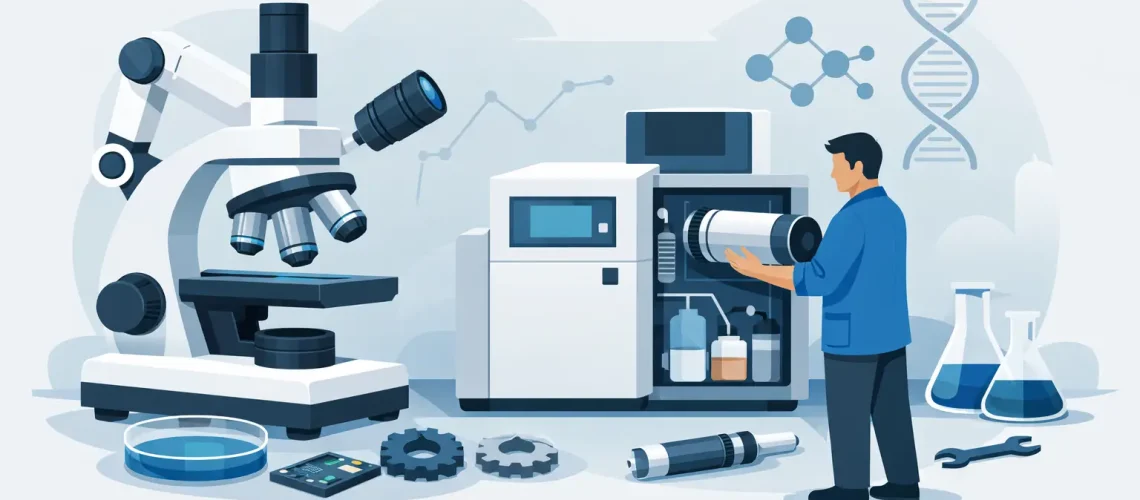
A centrifuge that suddenly runs hot, a PCR system with drifting thermal performance, or an analytical balance that no longer stabilizes – these are not minor inconveniences in a working lab. They disrupt schedules, compromise data quality, and create avoidable risk for regulated operations. Scientific instrument parts replacement is often the fastest, most cost-effective path back to reliable performance, but only when it is approached with technical discipline.
For research institutions, hospitals, industrial labs, and innovation teams, the real question is rarely whether a part can be replaced. The question is whether replacement will restore the instrument to the required standard of accuracy, safety, and operational confidence. That distinction matters because the wrong part, an incomplete diagnosis, or poor post-replacement verification can leave the same failure mode quietly embedded in the workflow.
Why scientific instrument parts replacement matters
In scientific environments, equipment uptime is only one part of the equation. A functioning instrument that produces inconsistent results can be more damaging than one that is visibly offline. When a detector weakens, a pump loses efficiency, a seal degrades, or a control board begins to fail intermittently, the impact often appears first in the data rather than the hardware.
This is why scientific instrument parts replacement should be treated as a performance strategy, not just a repair task. Replacing worn or failing components at the right time protects measurement integrity, extends instrument life, and reduces the chance of secondary damage. In many cases, a delayed replacement turns a manageable service event into a more expensive system failure.
There is also a compliance dimension. Laboratories operating under quality systems, hospital environments, and industrial testing facilities need confidence that instruments remain fit for purpose after service. A replacement process that includes proper diagnosis, part matching, installation, calibration, and verification supports traceability and reduces audit exposure.
Not every failure calls for full replacement
One of the most common mistakes in equipment management is assuming that degraded performance means the entire instrument is nearing end of life. Sometimes that is true, especially with obsolete systems or repeated failures across multiple subsystems. Often, though, the issue is localized.
A damaged touchscreen, aging sensor, unstable power module, cracked tubing assembly, worn gasket, failed motor, or contaminated optical component can frequently be addressed without replacing the full platform. For capital-intensive systems, this is an important distinction. The right service decision can preserve budgets for expansion, method development, or other strategic investments.
That said, part replacement is not always the best answer. If the instrument has poor serviceability, discontinued support, repeated downtime, or outdated control architecture that limits validation and interoperability, broader refurbishment or replacement may be the stronger long-term choice. It depends on the age of the platform, the criticality of the workflow, and the availability of qualified technical support.
How to judge when replacement is the right move
The strongest replacement decisions are based on evidence rather than urgency alone. A lab manager might first notice slower startup, unusual noise, elevated temperature, signal drift, failed self-checks, or inconsistent output. Those symptoms point to a fault, but they do not confirm the root cause.
A sound technical assessment should consider service history, usage patterns, environmental conditions, and the relationship between the failed component and surrounding assemblies. For example, replacing a pump head without checking fluid path contamination or pressure instability may solve only part of the problem. Replacing a heating element without examining control circuitry can lead to repeat failure.
There is also a practical business case to weigh. If a part replacement can restore validated performance with limited downtime, it is usually a strong option. If the same instrument has become a recurring service burden and replacement parts are increasingly difficult to source, a more strategic equipment transition may be warranted.
Scientific instrument parts replacement and data integrity
In high-value research and regulated testing, data integrity sits at the center of every maintenance decision. Instrument components affect more than mechanics. They influence sensitivity, repeatability, temperature stability, fluid control, motion accuracy, and software-mediated system behavior.
Consider what happens when an aging optical assembly in a spectrometric system loses consistency. The instrument may still run samples, but baseline quality, detection limits, or repeatability can shift enough to affect interpretation. The same applies to thermal cyclers with inconsistent heating blocks, pipetting systems with worn seals, or incubators with failing sensors. The instrument appears operational while the science becomes less dependable.
That is why replacement should be followed by verification matched to the instrument’s purpose. Functional testing alone may be enough for some noncritical systems. For analytical, diagnostic, or regulated workflows, calibration and performance qualification may also be necessary. Trusted partnerships matter here because technical service should not stop at the installation of a component. It should restore confidence in the entire working system.
The sourcing question: compatibility, quality, and traceability
Part sourcing is where many replacement efforts succeed or fail. The lowest-cost component is not always the lowest-cost decision. Scientific instruments are sensitive systems, and compatibility is rarely limited to physical fit. Electrical characteristics, material tolerances, firmware interaction, pressure ratings, thermal response, and chemical resistance can all affect outcome.
For that reason, replacement parts should be evaluated against the instrument model, application demands, and service objective. In some cases, original manufacturer parts are the most reliable route. In others, equivalent components can be appropriate if they meet technical requirements and can be validated in use. The key is traceability and informed selection.
This is especially relevant for institutions managing mixed fleets of legacy and current instruments. A partner with both sourcing capability and engineering understanding can often reduce downtime by identifying suitable options faster, including hard-to-find components, refurbishment pathways, or custom-fabricated adaptations where standard supply is limited.
Why installation quality matters as much as the part itself
Even a correct component can perform poorly if installed without the right procedure. Scientific equipment often requires alignment, torque control, contamination control, firmware checks, software configuration, leak testing, recalibration, or environmental stabilization after service. Missing one of these steps can compromise both performance and safety.
This is where hands-on technical capability becomes a differentiator. A service provider that understands biomedical equipment, advanced laboratory systems, and applied R&D workflows can assess the broader operating context, not just the failed part. That matters in facilities where equipment supports time-sensitive studies, diagnostic processes, or tightly scheduled production activities.
CLONEX approaches support from that broader operational perspective. For customers managing research, hospital, and industrial environments, the value is not simply in obtaining a replacement part. It is in restoring a working instrument with the speed, technical precision, and verification needed to keep science and operations moving forward.
Building a smarter replacement strategy
The most resilient organizations do not wait for visible failure before acting. They monitor instrument behavior, track service intervals, maintain records of recurring faults, and identify high-risk wear components before they disrupt workflows. That approach turns replacement from a reactive expense into planned reliability management.
A stronger strategy usually includes a review of critical instruments, expected wear patterns, spare part availability, calibration needs, and downtime tolerance. Some labs benefit from keeping select fast-moving parts in reserve. Others are better served by an external partner with secure inventory access, technical diagnostics, and cross-disciplinary repair support. The right model depends on instrument criticality, internal engineering resources, and procurement lead times.
It is also worth thinking beyond direct replacement. In some situations, custom brackets, 3D-printed lab adaptations, updated assemblies, or workflow-specific modifications can improve usability and extend system value. That is especially useful when older instruments still serve a valid scientific purpose but need practical engineering support to remain effective in a modern lab environment.
Scientific instrument parts replacement works best when it is handled as part of a larger reliability and performance strategy. The goal is not simply to make equipment power back on. The goal is to return systems to stable, defensible operation with minimal disruption to research, diagnostics, or industrial output. When that standard guides every service decision, replacement becomes more than maintenance – it becomes a way to protect momentum where precision matters most.