
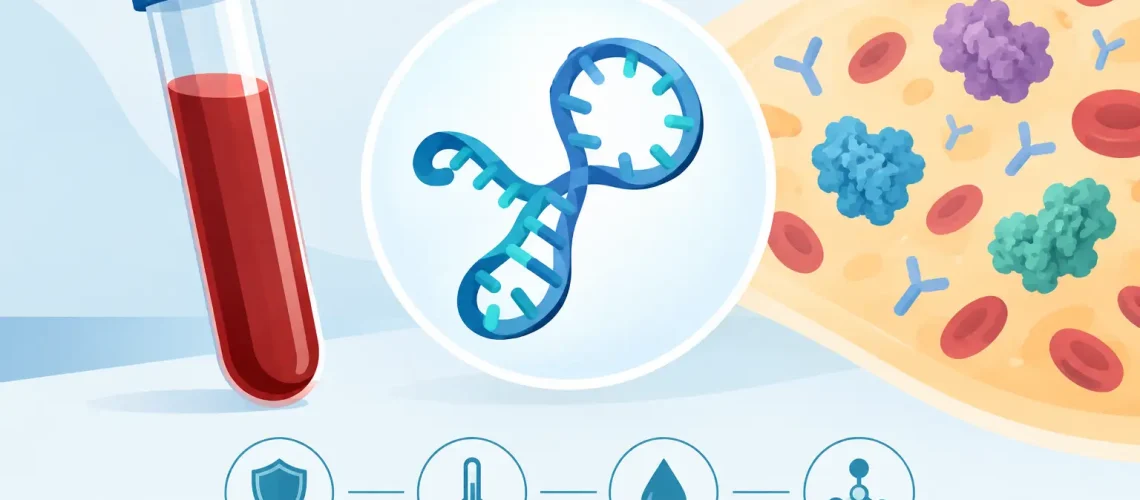
Aptamers can bind clinically relevant targets with antibody-like selectivity, yet a high-affinity sequence in buffer can fail quickly after contact with serum. So, are aptamers stable in serum? The accurate answer is: some are, but unmodified DNA and especially RNA aptamers often require deliberate engineering before serum exposure is compatible with the intended assay or therapeutic window.
For laboratory and product-development teams, serum stability should not be treated as a generic molecular property. It is a performance requirement defined by the matrix, temperature, incubation time, aptamer concentration, target abundance, readout method, and acceptable loss of signal. A sequence that remains functional for 30 minutes in diluted serum may be suitable for one diagnostic workflow and wholly inadequate for systemic delivery.
Why Serum Challenges Aptamer Performance
Serum contains nucleases, proteins, salts, metabolites, lipoproteins, and other components that can alter both an aptamer’s integrity and its accessible conformation. The most obvious risk is enzymatic degradation. Endonucleases and exonucleases can cleave oligonucleotides, reducing the concentration of intact aptamer and producing fragments that no longer bind the target as designed.
RNA aptamers are generally more vulnerable than DNA aptamers because the 2′-hydroxyl group on ribose contributes to chemical and enzymatic susceptibility. Native RNA may degrade rapidly in serum, often on a timescale that is incompatible with extended incubations. DNA aptamers frequently perform better, but they are not automatically serum-stable. Their fate depends on sequence composition, structure, terminal accessibility, and the nuclease activity of the particular sample.
Degradation is only one part of the problem. Serum proteins can bind nonspecifically to the aptamer or to its label, mask the target-binding domain, or shift the equilibrium away from the functional folded state. Electrolytes and divalent cations can also change secondary and tertiary structure. An aptamer selected and characterized in a simple selection buffer may therefore show a lower apparent affinity in serum even when the full-length molecule remains intact.
Are Aptamers Stable in Serum After Chemical Modification?
Chemical modification is the most established route to improving serum persistence, but it must be selected with the aptamer’s binding mechanism in mind. The wrong modification can preserve the strand while weakening target recognition.
For RNA aptamers, 2′-fluoro, 2′-O-methyl, and 2′-amino modifications are widely used to reduce nuclease susceptibility. Locked nucleic acids and other constrained analogs may further increase resistance in selected applications. These approaches can substantially extend functional half-life, although incorporation may alter local geometry, folding, or the residues directly responsible for target contacts.
Terminal protection is often equally practical. Exonuclease activity can be reduced through 3′ end capping, inverted deoxythymidine, phosphorothioate linkages, or strategically placed modified nucleotides. Because terminal modifications may be simpler to introduce than full-sequence modification, they can be a useful first optimization step for a DNA aptamer that is otherwise performing well.
Conjugation can also improve circulation behavior. Polyethylene glycol, lipid groups, albumin-binding moieties, and nanoparticle formulations may increase apparent residence time by limiting renal clearance or physically shielding the aptamer. These solutions introduce trade-offs: larger constructs can change tissue distribution, create steric interference, complicate manufacturing, or increase nonspecific interactions. Stability and pharmacokinetics are related, but they are not interchangeable measures.
Functional Stability Matters More Than an Intact Band
A denaturing gel, capillary electrophoresis result, or mass-spectrometry profile can show whether an aptamer remains chemically intact after serum incubation. That information is necessary, but it is not sufficient. A structurally intact aptamer may still lose target affinity because serum components affect folding or compete for binding.
Functional stability testing should therefore pair integrity measurements with a target-binding or assay-performance readout. For a diagnostic aptamer, this may mean measuring recovery, limit of detection, signal-to-background ratio, and precision in pooled human serum and in individual donor samples. For a therapeutic candidate, testing may include intact-molecule quantification alongside cell-based activity, plasma protein binding, and pharmacokinetic analysis.
The distinction becomes critical when a fluorescent, electrochemical, or enzyme-linked reporter is attached. The label itself can change how the molecule behaves in serum. Fluorophores may bind proteins, quench unexpectedly, or suffer matrix-dependent background. Surface-immobilized aptamers face an additional concern: surface density and orientation can restrict folding, even if the free aptamer is stable in solution.
Design Stability Into the Development Plan
The strongest serum-performing aptamers are usually developed through an iterative workflow rather than rescued at the end of a project. Selection conditions should resemble the intended application as early as practical. If the final assay must work in human serum, counter-selection against abundant serum proteins and validation in serum-containing matrices can prevent costly downstream surprises.
A productive evaluation plan typically addresses four linked questions:
- How quickly does the intact aptamer decline in the relevant serum or plasma matrix?
- Does the aptamer retain its target-binding affinity after incubation?
- Do matrix components increase nonspecific binding or interfere with the chosen readout?
- Does the resulting stability meet the actual handling, incubation, storage, or exposure time required by the application?
Human serum is not a universal substitute for every use case. Species differences in nuclease activity and protein composition matter in preclinical translation. Plasma and serum also differ: clotting-associated processing changes their composition, and anticoagulants used for plasma collection may affect metal-ion-dependent aptamer folding or assay chemistry. A candidate intended for whole-blood testing requires separate assessment, since cells, hemolysis, viscosity, and sample-processing delays add further variables.
Incubation conditions must be explicit. Results at room temperature cannot be assumed to predict 37 degrees C performance, and a 10% serum challenge does not establish behavior in neat serum. Similarly, pooled serum is useful for controlled screening but can hide donor-to-donor variability. For diagnostic development, testing a representative set of individual samples is often necessary before performance claims can be trusted.
Practical Options When Stability Is Insufficient
When an aptamer loses activity in serum, the next action should follow the failure mode. If nuclease cleavage is dominant, modified bases and terminal protection are logical candidates. If the full-length molecule persists but binding declines, re-examine folding conditions, spacer design, label placement, and nonspecific protein interactions. If the issue is poor target access in a complex matrix, sample preparation or a different assay architecture may be more effective than additional chemistry.
This is where computational analysis can provide practical value. Secondary-structure prediction, molecular modeling, and interaction analysis can help identify vulnerable termini, conserved structural motifs, or modification sites least likely to disrupt target recognition. Modeling does not replace serum testing, but it can narrow the design space and accelerate experimental cycles.
For aptamer-enabled diagnostics, assay format can be as influential as molecular stability. A short incubation followed by rapid washing may tolerate lower intrinsic serum stability than a homogeneous assay requiring prolonged exposure. Conversely, an aptamer intended for in vivo imaging or therapeutic delivery needs an exposure profile that supports distribution and activity over the relevant biological timeframe. There is no single half-life threshold that defines success.
Turning Serum Stability Into a Decision Criterion
Serum stability should be specified early as a measurable acceptance criterion, not described later as a favorable characteristic. Define the matrix, temperature, time points, intact-aptamer threshold, target-binding threshold, and assay performance requirement before comparing candidates. This turns aptamer optimization into a controlled technical decision rather than a sequence of isolated experiments.
Aptamers remain highly adaptable recognition elements for diagnostics, molecular analysis, and targeted development programs, but their value in serum depends on thoughtful chemistry and realistic validation. CLONEX supports this type of applied R&D through aptamer technology, molecular analysis, and tailored scientific problem-solving that connect molecular design to usable laboratory performance. The next useful question is not simply whether an aptamer survives serum, but whether it remains fit for the exact decision, measurement, or biological task it was designed to support.