
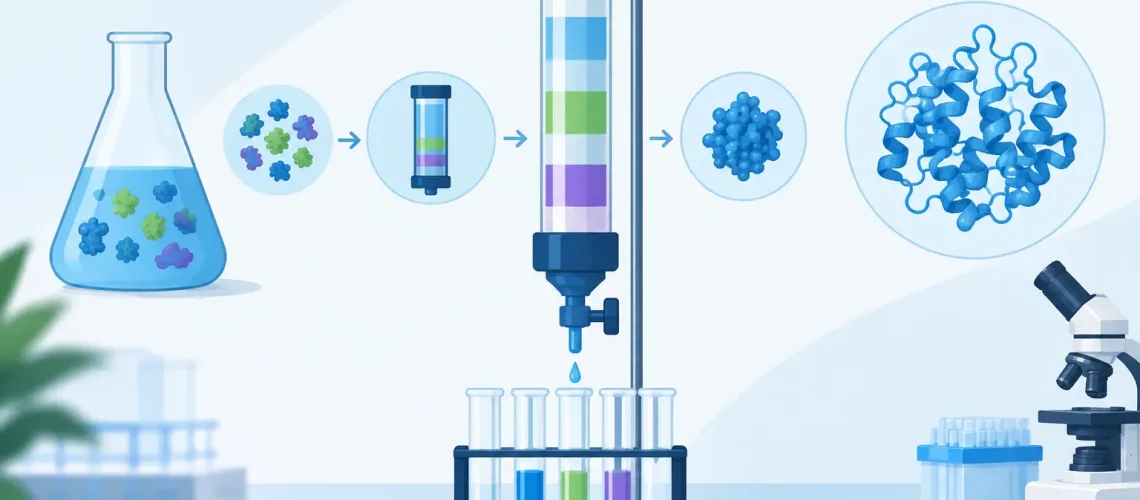
A protein can look highly expressed on an SDS-PAGE gel and still fail at the purification bench. It may bind weakly, precipitate during concentration, co-elute with host contaminants, or lose activity before characterization begins. The best techniques for protein purification are therefore not a fixed list of columns. They are a process decision based on the molecule’s properties, intended use, purity target, and the operational limits of the laboratory.
For research teams and industrial R&D groups, an effective strategy begins by defining what “pure” means for the project. A screening assay may tolerate minor host-cell proteins. Structural biology, diagnostic development, quantitative binding studies, and therapeutic research demand tighter control of identity, activity, aggregate content, endotoxin, and lot-to-lot consistency.
Best Techniques for Protein Purification: Start With the End Use
Purification should be designed backward from the final application. A recombinant enzyme intended for early functional screening needs enough active material quickly, while an antigen for assay development may require clean separation from closely related impurities. A protein for biophysical analysis must often be monodisperse and stable in a precisely defined buffer.
Before selecting a resin, assess the protein’s molecular weight, predicted isoelectric point, oligomeric state, solubility, cofactors, disulfide bonds, and sensitivity to pH, salt, reducing agents, or detergents. Expression host matters as well. Bacterial lysates, mammalian cell supernatants, insect cells, and plant extracts present different contaminant profiles and different risks of proteolysis or unwanted post-translational variation.
A useful purification workflow generally separates the task into three stages: capture, intermediate purification, and polishing. Capture rapidly concentrates the target from a complex feedstream. Intermediate steps remove the bulk of remaining contaminants. Polishing resolves aggregates, charge variants, degraded forms, or trace impurities that can interfere with downstream work.
Affinity Chromatography for Selective Capture
Affinity chromatography is often the most efficient first step when a suitable interaction is available. Histidine-tagged proteins are commonly captured with immobilized metal affinity chromatography, while GST, MBP, Strep-tag, Fc, biotin, and antigen-specific systems offer alternatives for proteins that express poorly or behave unpredictably with metal chelates.
The advantage is selectivity. A well-optimized affinity capture can produce a large increase in purity in one operation, reduce handling time, and protect fragile proteins from extended exposure to proteases. This makes it particularly valuable for low-abundance targets and time-sensitive workflows.
The trade-off is that affinity tags and ligands can introduce their own problems. Histidine-rich host proteins may co-purify, high imidazole concentrations may affect activity, and some targets bind poorly when a tag is inaccessible. If the tag must be removed, protease cleavage adds time and creates another separation requirement. For diagnostic or regulated workflows, residual ligand, metal carryover, and tag-related effects should be assessed rather than assumed to be negligible.
Native affinity approaches can be even more selective. Antibody-based immunoaffinity purification, lectin affinity media, or a receptor-ligand interaction may be appropriate when isolating native proteins, complexes, or glycoproteins. These methods can be powerful, but resin cost, elution conditions, and reusability need careful consideration.
Ion Exchange Chromatography for High-Capacity Cleanup
Ion exchange chromatography remains one of the most versatile techniques in protein purification because nearly every protein carries a net charge at a given pH. Anion exchange resins bind negatively charged proteins, while cation exchange resins bind positively charged proteins. The protein’s isoelectric point provides a starting point for choosing the mode, but small-scale scouting is still essential.
This method offers high binding capacity and strong resolution for host-cell proteins, nucleic acids, endotoxin, and product-related charge variants. It is often an excellent second step after affinity capture, particularly when a process needs to move toward scale-up. Salt gradients can reveal whether impurities separate cleanly from the target, while step elution may simplify a routine production workflow.
Conditions require discipline. Conductivity that is too high can prevent binding altogether. A pH too close to the protein’s isoelectric point may reduce binding and increase precipitation risk. Buffer selection also affects stability, especially for proteins that depend on divalent cations, cofactors, or a narrow pH range. The highest-resolution method is not automatically the best process if it compromises recovery or reproducibility.
Size Exclusion Chromatography for Final Polishing
Size exclusion chromatography, also called gel filtration, separates molecules by hydrodynamic size. It is especially useful for removing aggregates, separating oligomeric forms, exchanging buffers, and preparing samples for structural studies or sensitive functional assays.
For many laboratory-scale projects, size exclusion chromatography is the step that changes a merely clean sample into a dependable one. A symmetric peak at the expected elution volume can provide early evidence of sample homogeneity, while aggregate peaks signal potential concerns for stability, assay performance, or storage.
Its limitation is capacity. Size exclusion chromatography is generally inefficient for processing large volumes or heavily contaminated lysates. It works best after the target has already been concentrated and substantially purified. Overloading the column reduces resolution, and excessive concentration before loading can promote aggregation. When throughput matters, consider whether a different polishing method, such as ion exchange or mixed-mode chromatography, can address the critical impurity more efficiently.
Hydrophobic Interaction and Reverse-Phase Methods
Hydrophobic interaction chromatography separates proteins according to surface hydrophobicity under relatively mild aqueous conditions. Proteins bind at higher salt concentrations and elute as salt decreases. It can be highly effective when affinity and ion exchange methods leave persistent contaminants or when the target displays useful hydrophobic differences from impurities.
Reverse-phase chromatography provides sharper separation for some peptides and small proteins but uses organic solvents that can denature larger or sensitive proteins. It is commonly better suited to analytical assessment, peptide purification, or workflows where refolding is feasible. For active enzymes, antibodies, and conformationally sensitive proteins, hydrophobic interaction chromatography is often the more practical choice.
Mixed-mode resins combine ionic and hydrophobic interactions, providing another option for difficult separations. They can resolve impurities that overlap in conventional ion exchange, but method development is more complex because pH, salt type, and additive selection all influence binding. These resins are most valuable when conventional methods have been tested thoughtfully and have reached a clear limitation.
Protect Protein Quality Before It Reaches the Column
Chromatography cannot recover activity that was lost during lysis or clarification. Keep samples cold when appropriate, minimize hold times, and use protease inhibitors compatible with the planned purification chemistry. DNA-driven viscosity should be reduced through controlled nuclease treatment or mechanical processing, because viscous lysates compromise filtration, flow behavior, and column performance.
Clarification is not a minor preparation step. Inadequate centrifugation or filtration introduces particulates that foul resins and increase backpressure. For secreted proteins, depth filtration and membrane selection can influence yield before chromatography begins. For intracellular targets, lysis conditions should be optimized to release the protein without excessive heat generation, foaming, or shear damage.
Protein stability also depends on the buffer system. Salt, glycerol, reducing agents, detergents, arginine, and cofactors may improve recovery, but each additive can affect downstream binding, analytical methods, or final use. Test a limited set of conditions early using small aliquots rather than discovering instability after a full production run.
Verify Purity, Identity, and Function at Each Stage
A single gel image is not sufficient evidence that a protein is fit for purpose. SDS-PAGE is a fast and useful purity check, but it does not confirm native conformation, aggregate content, identity, or biological activity. Combine it with methods that answer the risks relevant to the project: analytical size exclusion for aggregation, Western blotting or mass spectrometry for identity, activity assays for function, and endotoxin testing when the material will be used in cell-based or biomedical applications.
Track recovery at every stage. A method that yields a visually pure band but recovers only a small fraction of active protein may not be the right method. Recording sample volume, total protein, target concentration, purity estimate, activity, and storage condition creates a practical process history that makes future batches easier to improve.
Build a Purification Platform, Not a One-Off Protocol
The most reliable workflows use a small number of orthogonal separation principles. For example, affinity capture followed by ion exchange and size exclusion combines specific binding, charge separation, and aggregate removal. That sequence will not suit every protein, but the underlying principle is widely applicable: each step should remove impurities that the preceding step cannot distinguish.
As programs move from research quantities toward repeated production, reproducibility becomes as important as peak purity. Standardize critical parameters such as feed conductivity, resin loading, flow rate, wash composition, elution criteria, and sample hold time. Laboratories with limited internal capacity can benefit from a technical partner that can align chromatography development with equipment readiness, analytical support, and scalable laboratory operations. CLONEX applies this integrated perspective to help teams advance scientific workflows with practical, tailored solutions.
The right purification strategy is the one that consistently delivers active, well-characterized protein at the scale and quality your next decision requires. Begin with the molecule’s behavior, test conditions deliberately, and let the intended application determine how far the process needs to go.