A laboratory can lose a full day not because an assay failed, but because a centrifuge is unavailable, a reagent has not arrived, a sample was entered incorrectly, or a workflow cannot adapt to an unexpected result. The future of laboratory automation is therefore not defined by placing more robots on benches. It is defined by building laboratory operations that respond intelligently, preserve scientific quality, and keep work moving when conditions change.
For research institutions, hospitals, biotechnology teams, and industrial R&D operations, automation is becoming an operating model rather than a single equipment purchase. The most valuable systems will connect instruments, consumables, data, maintenance, and human expertise into workflows that are easier to scale and easier to trust.
Automation Will Move From Isolated Tasks to Connected Workflows
Many laboratories began their automation journey with a clear bottleneck: liquid handling, plate washing, sample labeling, imaging, or repetitive dispensing. These systems remain valuable, particularly where throughput and repeatability are central to performance. Yet isolated automation can create a new problem when data and materials must still be transferred manually between instruments, software platforms, and operators.
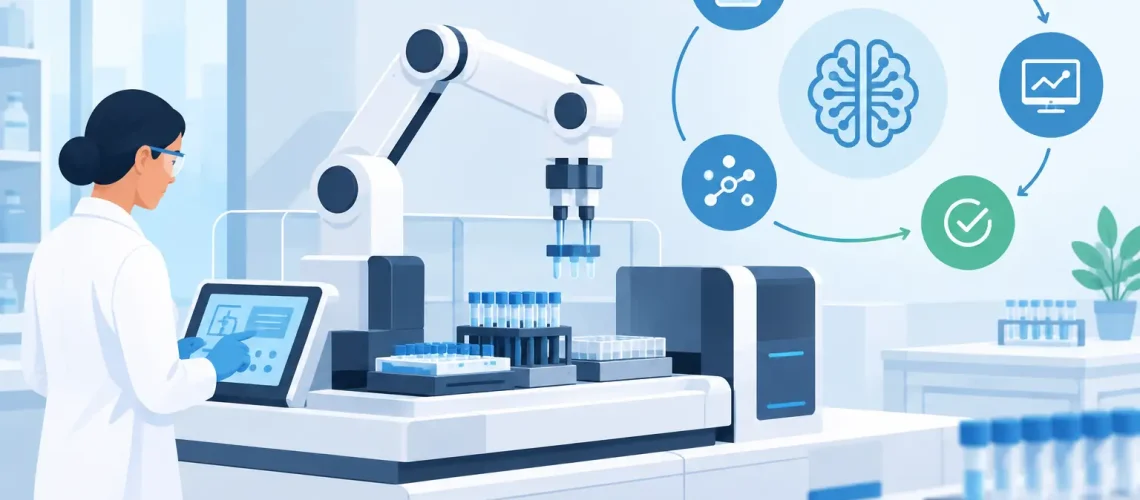
The next phase will focus on connected workflows. A liquid handler may receive sample priorities from a laboratory information management system, confirm reagent availability, route plates to an incubator or reader, and return validated results to the correct project record. When designed well, this reduces handoffs that introduce delays, transcription errors, and uncertainty around sample identity.
This does not mean every laboratory needs a fully autonomous facility. A high-throughput diagnostics laboratory, a university core facility, and a materials development team have very different requirements. The practical objective is to automate the points where manual activity creates the greatest risk, cost, or delay, then ensure those automated steps communicate with the wider laboratory workflow.
Interoperability Will Be a Procurement Priority
Laboratory managers increasingly need to ask whether new equipment can exchange data with existing systems, accept common plate and tube formats, and fit into established quality procedures. A technically advanced instrument that operates as a closed island may limit future expansion.
Open interfaces, standardized data structures, and modular hardware will matter as much as speed specifications. The ability to add an automated storage unit, barcode reader, robotic arm, or custom fixture later can protect an organization from costly redesign. This is especially relevant for growing R&D teams whose workflows change faster than their infrastructure budgets.
AI Will Improve Decisions, Not Replace Scientific Judgment
Artificial intelligence is likely to influence laboratory automation first through planning, monitoring, and interpretation. Rather than simply executing predefined instructions, software will help laboratories determine which samples should be prioritized, which experiments need repetition, and which instrument signals indicate a developing problem.
In molecular biology, an intelligent workflow could flag inconsistent controls before a batch moves to downstream analysis. In diagnostic development, algorithms may identify patterns in image or assay data that warrant expert review. In materials research, computational models can narrow experimental conditions before physical testing begins, allowing teams to direct laboratory capacity toward the most informative experiments.
The value is not automation for its own sake. It is a shorter path between observation and action. Scientists retain responsibility for experimental design, biological relevance, method suitability, and final interpretation. AI-generated recommendations are only as dependable as the data, controls, validation process, and governance behind them.
Organizations should be cautious of systems that present predictive outputs without clear traceability. In regulated and high-consequence environments, users need to understand what data informed a recommendation, whether the model has been validated for the intended use, and when human review is mandatory. Explainability and auditability will be practical requirements, not optional software features.
Data Integrity Will Become the Foundation of Automated Labs
As automation expands, laboratories will generate more data at every stage: sample receipt, reagent preparation, instrument status, environmental conditions, method parameters, raw measurements, and final reports. More data does not automatically produce better science. Without disciplined data architecture, it can make root-cause investigations more difficult.
Future-ready laboratories will treat data integrity as part of workflow design. Each sample needs persistent identification. Each run needs a documented method version. Each instrument should record relevant operating conditions, maintenance history, calibration status, and exceptions. Where data moves between platforms, the transfer must be controlled and traceable.
This is particularly important when research methods transition toward clinical validation, manufacturing support, or commercial deployment. A prototype workflow may tolerate manual annotations and informal file storage early in development. A diagnostic or regulated process cannot rely on those practices at scale.
Cybersecurity also deserves attention. Connected instruments and remote service capabilities can improve uptime, but they expand the digital environment that must be managed. Access controls, network segmentation, backup procedures, software patching, and vendor responsibilities should be considered during implementation rather than after a system is already in daily use.
Flexible Hardware Will Support Faster Scientific Change
The most effective automated laboratories will not be rigid production lines. Research rarely follows a fixed route for long. New assay formats, changing sample volumes, supply constraints, and evolving project priorities require systems that can be adapted without rebuilding the entire lab.
Modular automation provides a practical answer. Configurable deck layouts, interchangeable grippers, adaptable racks, and custom 3D-printed lab accessories can help teams accommodate nonstandard vessels, improve repeatable positioning, or connect instruments that were not originally designed to work together. Small physical adaptations often solve workflow problems that software alone cannot address.
Custom fabrication must still be approached with care. A 3D-printed adapter may be suitable for a research workflow but require additional material, cleaning, chemical compatibility, or validation assessment before use in controlled environments. The right choice depends on the application, the risk profile, and the documentation expected by the organization.
At CLONEX, this integration perspective matters because equipment availability, technical maintenance, computational analysis, molecular biology support, and custom laboratory adaptations all affect the same outcome: dependable scientific execution. Automation succeeds when infrastructure and scientific intent are planned together.
Instrument Reliability Will Shape Automation ROI
An automated workflow is only as available as its least reliable component. If a critical reader, incubator, pump, or robotic module is out of service, the effect can extend beyond one delayed experiment. Samples may degrade, schedules may be disrupted, and teams may be forced back to manual work without an equivalent validated process.
This is why maintenance, calibration, spare parts, and service response should be included in automation planning from the start. Procurement decisions based solely on capital cost can overlook the operational cost of downtime. Laboratories should evaluate service coverage, availability of replacement parts, local technical capability, preventive maintenance requirements, and the recovery plan for a failed run.
Automation can also make preventive maintenance more intelligent. Usage data, error logs, and performance trends can indicate when an instrument needs attention before it fails. This shifts maintenance from a reactive expense to a contributor to schedule confidence and data quality.
The Human Role Will Become More Specialized
There is a persistent misconception that automation reduces the need for skilled laboratory professionals. In practice, it changes where their expertise creates value. Teams spend less time on repetitive pipetting and manual recordkeeping, and more time on method development, exception handling, quality review, data interpretation, and experimental strategy.
This transition requires investment in training. Scientists need enough automation literacy to recognize poor workflow logic and interpret system exceptions. Automation specialists need sufficient scientific context to configure methods appropriately. IT, quality, engineering, and laboratory teams must share responsibility for systems that cross traditional departmental boundaries.
The laboratories that benefit most will involve end users early. A workflow designed only by equipment suppliers or only by software teams can miss the practical realities of contamination control, sample variability, ergonomic constraints, cleaning procedures, and peak-demand periods. User-led design helps automation support real work rather than impose another layer of complexity.
Planning for the Future of Laboratory Automation
The strongest automation roadmaps begin with operational questions, not a catalog of technologies. Where do samples wait? Which steps create rework? What information is missing when a result is questioned? Which instruments create the greatest risk of downtime? Where would faster feedback change a project decision?
From there, laboratories can prioritize targeted improvements while protecting flexibility for future integration. A staged approach often delivers better results than a single large deployment: stabilize core instruments, digitize sample and asset records, automate high-risk repetitive steps, connect data flows, then expand based on measured performance.
The laboratories that lead over the next decade will not necessarily be those with the most robotics. They will be the ones that pair intelligent tools with reliable infrastructure, traceable data, and people empowered to ask better scientific questions.