
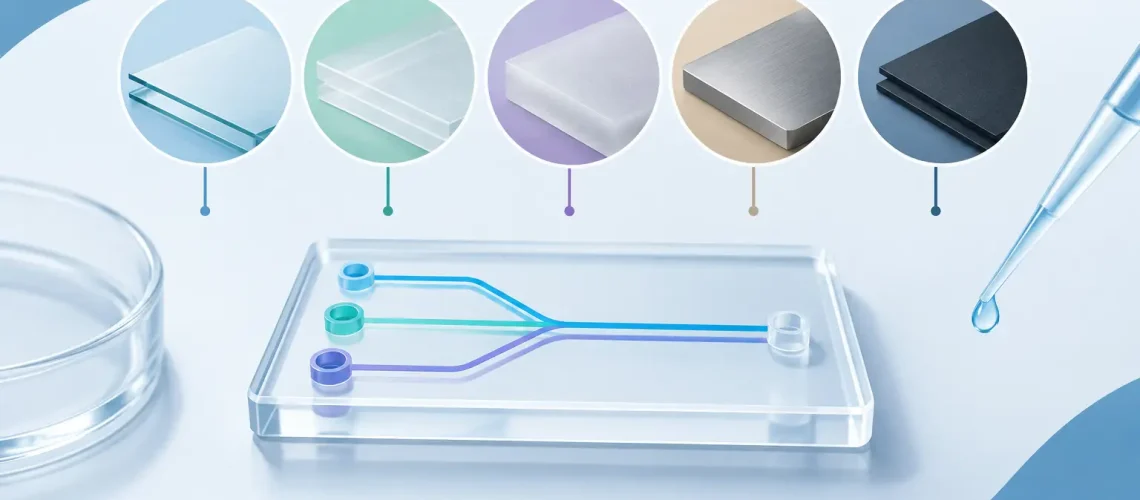
A microfluidic device can have an excellent channel design and still fail its intended assay because of the substrate. Adsorption can suppress a biomarker signal, solvent exposure can distort channels, and optical background can compromise imaging. Selecting the best materials for microfluidic devices is therefore a systems decision: the material must support the fluid, the assay chemistry, the fabrication route, and the pathway from prototype to validated deployment.
For research teams developing diagnostics, cell-based assays, sample preparation cartridges, or analytical platforms, early material selection reduces later redesign cycles. The right choice is rarely defined by one property alone. It is defined by the balance between performance, manufacturability, cost, and regulatory or operational requirements.
Start With the Operating Conditions
Material selection should begin with the sample and the workflow, not with the fabrication method available in the lab. A device handling aqueous buffers at low pressure has very different demands from a system performing organic-solvent extraction, high-pressure liquid handling, or long-term mammalian cell culture.
Chemical compatibility is the first screen. Solvents, surfactants, acids, bases, and fluorescent dyes may swell, crack, extract compounds from, or adsorb onto certain polymers. Next, consider mechanical requirements. Thin membranes, pressure-driven flow, pneumatic valves, and high-throughput operation each require known dimensional stability and predictable bonding strength.
Optical needs matter just as much in many biomedical applications. For fluorescence microscopy, optical clarity, low autofluorescence, and low birefringence are often essential. For molecular diagnostics, low nonspecific binding may be more important than transparency. If a device will move beyond proof of concept, teams should also assess moldability, raw-material consistency, sterilization tolerance, and traceability at this stage.
Best Materials for Microfluidic Devices by Use Case
No universal winner exists. The materials below are widely used because each solves a distinct set of technical and commercial constraints.
PDMS for fast prototyping and cell studies
Polydimethylsiloxane, commonly called PDMS, remains a leading material for academic microfluidics. It can be cast rapidly from a master mold, bonded to glass after plasma treatment, and used to create intricate channels with relatively low equipment investment. Its gas permeability supports oxygen exchange, making it particularly useful for cell culture, organ-on-chip research, and systems that use pneumatic microvalves.
PDMS also has limitations that become significant in analytical and translational work. It absorbs many hydrophobic small molecules, which can alter drug concentrations and reduce assay reproducibility. It may leach low-molecular-weight components, and its mechanical properties can shift under some solvents. Plasma-treated surfaces can recover hydrophobicity over time, making surface control a recurring concern.
PDMS is often the correct choice when a team needs design iteration within days and expects to refine the biology or fluidics. It is less suitable when precise quantitative recovery of hydrophobic analytes, long shelf life, or high-volume manufacturing is central to the program.
COC and COP for diagnostics and scalable cartridges
Cyclic olefin copolymer (COC) and cyclic olefin polymer (COP) are high-value options for diagnostic consumables and scalable microfluidic cartridges. These thermoplastics offer excellent optical clarity, low water absorption, good chemical resistance to many aqueous reagents, and lower autofluorescence than several commodity plastics.
Their low protein-binding characteristics can be advantageous for immunoassays, nucleic acid workflows, and sensitive detection platforms, although surface treatment may still be required depending on the analyte. COC and COP can be processed through injection molding, hot embossing, laser machining, and thermal or ultrasonic bonding, supporting a realistic route from development to production.
The trade-off is process complexity during early development. Tooling, bonding windows, and surface functionalization require optimization. Teams should also verify grade-specific compatibility, because the performance of COC and COP depends on resin formulation, processing temperature, and the intended sterilization method.
PMMA for economical optical prototypes
Polymethyl methacrylate, or PMMA, is a practical thermoplastic for prototype devices that need good transparency and straightforward machining. It is readily milled, laser cut, and bonded, making it useful for larger channels, fluidic manifolds, educational systems, and early-stage analytical prototypes.
PMMA generally costs less than specialty cyclic olefins and supports rapid design changes without silicone molding. However, it has lower resistance to many organic solvents and can show more autofluorescence than COC, COP, or glass. Its surface may also require treatment when managing protein adsorption or cell attachment.
For teams evaluating geometry, flow distribution, or instrument integration, PMMA can provide an efficient development platform. For highly sensitive fluorescence detection or solvent-intensive chemistry, another material may be the better fit.
Glass for analytical precision and surface chemistry
Glass remains a benchmark for microfluidic devices that demand optical performance, chemical resistance, and stable surface chemistry. It is compatible with a broad range of solvents and can withstand higher temperatures than most polymers. Its low autofluorescence and optical quality make it well suited to microscopy, electrophoresis, spectroscopy, and applications requiring precise optical readout.
Glass surfaces can also be functionalized with established silane chemistry, enabling controlled attachment of capture molecules, hydrogels, or anti-fouling layers. In electrokinetic systems, its stable surface charge can be a major advantage.
The cost is fabrication difficulty. Etching, drilling, alignment, and bonding are more specialized than polymer processing, and device geometries can be constrained by the process. Glass is typically selected when assay confidence, chemical durability, or optical precision justifies the additional engineering investment.
Silicon for integrated sensing and advanced engineering
Silicon is valuable when a microfluidic platform must integrate microelectronics, thermal control, pressure sensing, or highly precise microstructures. Semiconductor manufacturing methods enable exceptional feature control, and silicon’s thermal conductivity supports applications involving temperature-sensitive reactions, such as PCR and thermal cycling.
Its limitations are equally clear. Silicon is opaque in the visible range, more expensive than common polymers, and usually unnecessary for a stand-alone disposable cartridge. It is best reserved for specialized analytical instruments, MEMS integration, or applications where device-level sensing and thermal performance are strategic requirements.
Surface Behavior Can Matter More Than Bulk Material
A material that appears chemically suitable may still produce inconsistent results because of its surface. Protein adsorption, nucleic acid loss, cell adhesion, bubble formation, and poor wetting can all originate at the channel wall. This is especially relevant when sample volume is low and surface-area-to-volume ratios are high.
Hydrophilic coatings, plasma activation, grafted polymers, silanization, and biomolecule immobilization can tailor device behavior. Yet surface modification introduces its own validation work. Teams need to establish coating uniformity, storage stability, compatibility with bonding steps, and batch-to-batch reproducibility.
For diagnostic development, the material and the surface treatment should be qualified as one system. A low-binding polymer with a poorly controlled coating may be less reliable than a material with a mature, well-characterized functionalization process.
Align the Material With Manufacturing Early
A common development mistake is treating a PDMS prototype as though it will transfer directly to a thermoplastic production device. Channel aspect ratios, bonding methods, tolerances, and surface behavior may all change during that transition. The resulting redesign can affect flow resistance, reagent retention, detection sensitivity, and even user handling.
A more efficient approach is to define the anticipated manufacturing route early. Soft lithography may be appropriate for research validation. Hot embossing can suit pilot-scale thermoplastic production. Injection molding becomes compelling when volumes rise and per-unit cost matters. For small batches of fixtures, adapters, and non-fluid-contact components, laboratory 3D printing can accelerate iteration, though material biocompatibility, resolution, and uncured resin exposure must be assessed carefully.
Material availability is also an operational consideration. Institutions and industrial teams benefit from specifying resin grades, sheet stock, adhesives, coatings, and bonding procedures that can be sourced consistently. A technically successful device cannot move efficiently if its critical materials have uncertain lead times or changing specifications.
A Practical Material Selection Framework
Before committing to a device architecture, define the target use profile: analytes, reagents, flow pressure, detection mode, shelf life, sterilization method, and expected production quantity. Use this profile to eliminate unsuitable materials before investing in molds or validation studies.
Then test representative coupons and simple channels under real assay conditions. Measure recovery of key analytes, fluorescence background, dimensional change, bond integrity, wetting behavior, and extractables where relevant. Testing should include the full exposure time, not only a brief compatibility check. A polymer may appear stable during a 10-minute run yet drift during a 24-hour incubation.
Finally, select the material with the lowest overall development risk, not simply the lowest initial cost. For a cell-culture platform, that may be PDMS. For a disposable fluorescence diagnostic cartridge, COC or COP may offer the stronger production pathway. For solvent-heavy analytical work, glass may be the decisive choice.
CLONEX supports this decision process through tailored scientific solutions that connect materials evaluation, computational analysis, laboratory prototyping, and practical R&D execution. The most effective microfluidic platform is one whose material behavior has been engineered around the assay from the first prototype onward.