
A PCR master mix that performs inconsistently, an antibody with rising background signal, or a control that suddenly falls outside specification can all point to the same operational issue: reagent degradation. Understanding what causes reagent degradation is not simply a storage concern. It is a critical part of protecting analytical confidence, controlling repeat work, and maintaining continuity across research, diagnostic, and industrial workflows.
Reagents do not fail in one uniform way. Their stability depends on molecular composition, formulation, packaging, shipping history, storage conditions, and how they are handled after opening. A buffer may drift in pH, an enzyme may lose catalytic activity, a fluorescent probe may photobleach, and a hygroscopic powder may absorb enough moisture to change concentration or reconstitution behavior. The practical response must therefore be tailored to the reagent and the workflow.
What Causes Reagent Degradation Most Often?
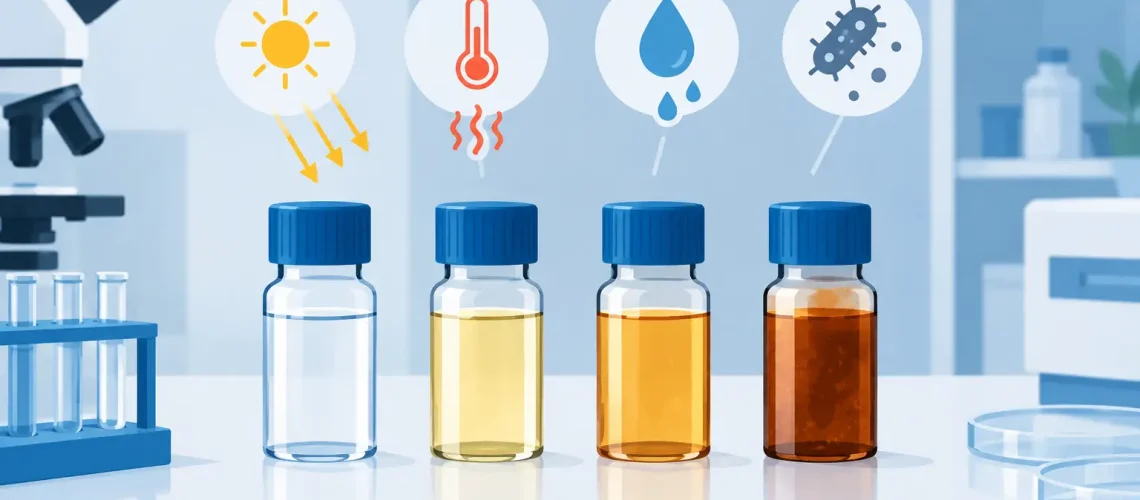
Temperature exposure, light, moisture, contamination, oxidation, repeated freeze-thaw cycles, and expiration-related chemical change are the primary causes. These factors can act independently, but laboratory problems often arise from their combined effect. For example, an enzyme exposed to several freeze-thaw cycles may remain usable until a prolonged bench setup period adds thermal stress and microbial contamination risk.
Temperature excursions and thermal cycling
Temperature is among the most consequential variables because reaction rates generally increase as temperature rises. Even a short excursion can accelerate hydrolysis, denature proteins, destabilize nucleic acids, or alter the performance of temperature-sensitive diagnostic components. The risk is particularly high for enzymes, antibodies, cell culture supplements, fluorescent dyes, and standards with narrow stability specifications.
Repeated freezing and thawing creates a different but equally significant challenge. Ice formation can concentrate salts and solutes in the remaining liquid phase, change local pH, and stress protein structure at the ice-liquid interface. A reagent may look normal after thawing while experiencing a meaningful loss of performance. Aliquoting into validated working volumes is often the most effective control, provided aliquots are prepared under clean conditions and labeled with sufficient traceability.
Not every product requires the coldest available storage. Some formulations are damaged by freezing, while others require storage at -20°C or -80°C to preserve activity. Product-specific instructions, including allowable short-term room-temperature exposure, should guide storage decisions rather than a general assumption that colder is always better.
Light exposure and photochemical damage
Light-sensitive reagents degrade when photons trigger chemical reactions or alter molecular structure. Fluorophores, chromogenic substrates, photosensitive drugs, vitamin-containing media, and certain probes are common examples. Direct sunlight is an obvious concern, but sustained exposure to strong laboratory lighting can also affect sensitive materials over time.
Amber vials, foil wrapping, opaque secondary containers, and closed refrigerator storage are simple safeguards. The key is consistency. A reagent protected during long-term storage can still degrade if it remains on an illuminated benchtop throughout repeated assay preparation. For fluorescence-based workflows, protecting reagents, standards, and prepared plates from light should be built into the method, not left to individual preference.
Moisture, humidity, and hydrolysis
Many powdered reagents are hygroscopic, meaning they absorb water from the surrounding air. Once moisture enters a container, it can promote hydrolysis, cause clumping, change mass-based concentration, and reduce solubility. Lyophilized enzymes, primers, salts, desiccant-sensitive materials, and reactive chemical powders all require disciplined moisture control.
The risk grows when containers are opened repeatedly in humid conditions or left uncapped during weighing and dispensing. Allowing cold containers to equilibrate while sealed before opening can reduce condensation. Using dry, clean tools and promptly resealing containers also matters. In higher-control environments, humidity monitoring and dry-storage systems may be justified for materials whose performance or replacement cost makes exposure unacceptable.
Oxygen, reactive chemicals, and material compatibility
Oxidation is a gradual but common pathway for degradation. Oxygen can alter susceptible compounds, particularly lipids, reducing agents, dyes, and other chemically reactive formulations. Trace metals, residual cleaning chemicals, and incompatible container materials can accelerate these reactions.
Container selection is part of reagent control. Some materials adsorb proteins or nucleic acids, while others allow gas transmission or interact with solvents. For highly sensitive applications, laboratories should evaluate whether the supplied primary packaging remains suitable after dispensing into working aliquots. Low-binding tubes, chemically compatible vials, and validated closures may protect both reagent integrity and assay recovery.
Contamination during routine use
A reagent can become compromised even when its chemical structure remains largely intact. Microbial contamination, nuclease introduction, cross-contamination with samples, and carryover from incompatible reagents can all degrade practical performance. Water, buffers, cell culture reagents, and molecular biology components are especially vulnerable when aseptic or clean-handling practices are inconsistent.
Using dedicated pipettes, filtered tips where appropriate, clean dispensing areas, and single-use aliquots reduces exposure pathways. For RNA workflows, RNase control must extend beyond the reagent bottle to gloves, bench surfaces, tubes, and instruments. In clinical or quality-controlled laboratories, contamination prevention should be supported by documented procedures, training, and deviation review rather than informal habits alone.
Signs That a Reagent May Be Degraded
Visual inspection is useful but not sufficient. Precipitation, discoloration, unexpected turbidity, phase separation, or damaged packaging may indicate a problem, yet many degraded reagents appear unchanged. Functional evidence is often more reliable: lower signal intensity, increased background, slower reaction rates, poor standard-curve linearity, variable replicate results, or control failures.
When results shift, avoid immediately attributing the issue to the reagent. Instrument calibration, consumable quality, environmental conditions, operator technique, and sample integrity can produce similar symptoms. A structured investigation should compare a retained or newly opened lot, review storage logs and shipping records, confirm instrument performance, and assess whether deviations align with a specific reagent, date, or workflow step.
A Practical Stability-Control Strategy
Effective reagent management is a system, not a refrigerator setting. Begin by identifying materials that are high value, highly sensitive, difficult to replace, or central to regulated testing. These reagents deserve more detailed controls, including continuous temperature monitoring, alarm response procedures, receipt inspection, and lot-level performance verification.
For day-to-day operations, inventory practices make a measurable difference. Record receipt date, opening date, expiration date, storage location, lot number, and any manufacturer-defined in-use period. Apply first-expire, first-out logic when suitable, but do not use it as a substitute for checking storage history. A newer lot exposed to an unrecorded freezer failure may be less reliable than an older, correctly stored material.
Cold-chain management also extends beyond the laboratory. Reagents can be affected during transit, loading-dock delays, internal transfer, or temporary storage while equipment is serviced. Receiving personnel should know which deliveries require immediate action and what evidence to retain if a shipment arrives warm, frozen unexpectedly, leaking, or physically damaged. Temperature indicators can provide useful context, although they must be interpreted against the product’s documented stability limits.
Laboratories should validate practical handling windows for critical reagents. If a master mix is routinely kept on ice for three hours during high-throughput preparation, that condition should be supported by supplier data or internal verification. If a reagent is aliquoted, transferred to a different container, or incorporated into a custom workflow, its original stability claim may not fully apply.
When Storage Infrastructure Becomes the Limiting Factor
A well-written SOP cannot compensate for an unreliable refrigerator, overloaded freezer, poorly placed temperature probe, or incomplete alarm process. Equipment performance directly influences reagent quality. Preventive maintenance, calibration, mapping where required, backup capacity, and documented emergency response protect materials when routine operations are disrupted.
This is where a cross-disciplinary support model adds value. CLONEX can help organizations align reagent storage needs with dependable laboratory equipment, technical maintenance, and operational planning, particularly where research continuity depends on sensitive molecular and diagnostic materials. The objective is not merely to store products, but to maintain the conditions needed for defensible scientific output.
Reagent degradation is often preventable when laboratories treat storage, handling, and equipment reliability as connected parts of one quality system. The most useful next step is to review the materials that would cause the greatest disruption if they failed, then build controls around their actual vulnerabilities rather than relying on a one-size-fits-all storage routine.